Next-Gen AI Hardware & Benchmarks: MSI RTX Spark Laptops, AutoIndexer, and SWE-Duel
The artificial intelligence landscape continues to evolve at a blistering pace, spanning groundbreaking hardware releases, innovative causal language model architectures, and dynamic self-scaling evaluation frameworks. In this roundup, we examine three major developments shaping the future of computing: NVIDIA and MediaTek's new RTX Spark SoC powering high-end MSI laptops, the AutoIndexer decoding mechanism for causal models, and SWE-Duel, a self-scaling arena for coding agents.
1. Local AI on the Move: MSI RTX Spark Laptops Available for Pre-Order
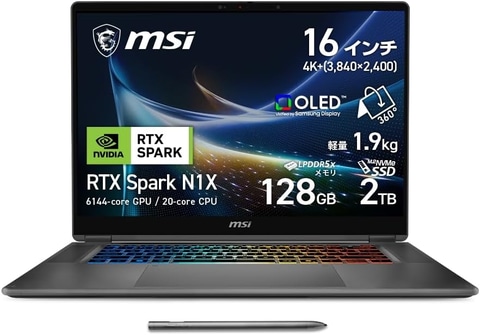
Amazon has opened pre-orders for MSI's groundbreaking line of notebooks powered by the RTX Spark system-on-chip (SoC)—a collaborative development between NVIDIA and MediaTek. Designed specifically to run local AI workloads and generative AI agents smoothly, the RTX Spark architecture integrates up to 20 Arm CPU cores and a Blackwell-generation GPU into a single chip, sharing up to 128GB of unified memory.
The new MSI Prestige N16 Flip AI+ C1XM series features a 360-degree convertible 2-in-1 form factor and comes in two primary configurations:
-
Prestige-N16-Flip-AI+C1XMT-3100JP
- Price: ¥1,459,800
- SoC: RTX Spark N1X (20-core CPU, 6,144 CUDA cores)
- Memory / Storage: 128GB Unified Memory / 2TB SSD
- Display: 16-inch 4K+ (3,840 × 2,400)
- OS: Windows 11 Pro
-
Prestige-N16-Flip-AI+C1XMT-3200JP
- Price: ¥1,099,800
- SoC: RTX Spark N1X (20-core CPU, 6,144 CUDA cores)
- Memory / Storage: 64GB Unified Memory / 2TB SSD
- Display: 16-inch QWXGA+ (2,880 × 1,800)
- OS: Windows 11 Pro
Scheduled for release on October 31, these machines bring workstation-class local AI capabilities straight to mobile professionals.
2. Flexible-Order Decoding: AutoIndexer (arXiv:2610.12545)

Standard autoregressive decoding struggles with non-causally ordered data—such as cross-references and future dependencies—because outputs cannot easily be revised post-hoc. While diffusion LLMs offer partial relief, they still fall short when arbitrarily inserting or removing tokens from an existing context.
Researchers introduced AutoIndexer, a novel generative model that simulates a Chain of Edits. Key features include:
- Text-Editor-Like Capabilities: The model predicts marker tokens to open and close edits while moving a cursor across the token sequence.
- Robustness: Trained by perturbing ground-truth labels with inverse chained edit operations, making it highly resilient to erroneous context and ideal for tasks like code correction.
- No Performance Compromise: It retains standard LLM benchmark performance while unlocking advanced post-generation context-editing functions.
3. SWE-Duel: Self-Scaling Arenas for Coding Agents (arXiv:2610.12569)
Static coding benchmarks inevitably suffer from data leakage and task saturation as models improve. To counter this, researchers proposed SWE-Duel, a dynamic arena where two coding agents evaluate each other in mirrored Red-Blue turns.
How SWE-Duel Works:
- The Red Turn: An agent implements a new feature with tests, deliberately embeds a subtle bug, and creates sealed bug-triggering tests. The pull request is accepted only if it passes standard feature tests but fails the bug tests, and if the same agent can successfully repair the bug blind.
- The Blue Turn: A second agent reviews and revises the pull request without knowing a bug exists. It wins only if all test suites pass.
- Tournament Findings: In a 1,500-turn tournament across 15 repositories and 5 languages:
- GPT-5.5 with Codex CLI emerged as the strongest solver, repairing 98.3% of reviewed defects.
- Claude Opus 4.8 with mini-swe-agent proved to be the strongest task author, achieving a 27.3% Red win rate.
Summary Comparison
| Area | Technology / Project | Key Innovation / Focus | Target Audience / Use Case | | :--- | :--- | :--- | :--- | | Hardware | MSI Prestige N16 Flip (RTX Spark) | NVIDIA + MediaTek SoC with Blackwell GPU & Arm CPU | Local generative AI and agent workloads | | Model Architecture | AutoIndexer | Causal models trained on chains of edits | Flexible-order decoding & code correction | | Evaluation | SWE-Duel | Self-scaling coding agent tournament arena | Dynamic benchmark generation & stress testing |
As hardware advances to support massive local memory pools and algorithmic research pushes past traditional autoregressive limits, the ecosystem is rapidly maturing toward truly adaptive, autonomous AI systems.